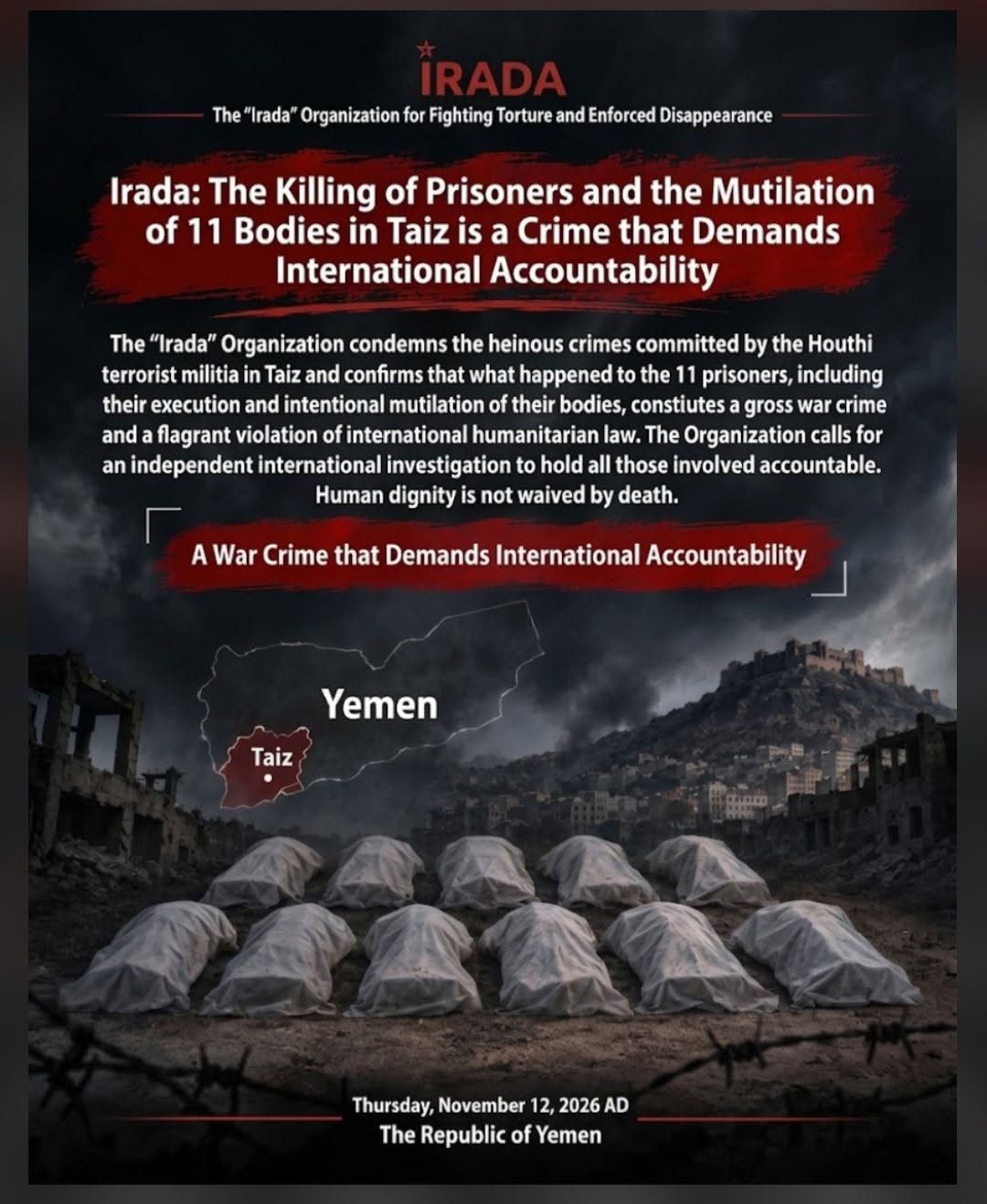
Irada: The Killing of Prisoners and Mutilation of 11 Bodies in Taiz Is a Crime That Demands International Accountability
The Irada Organization against Torture and Enforced Disappearance condemns in the strongest possible terms the brutal crimes and horrific violations committed by the Houthi terrorist militia in Taiz Governorate
Among these violations is the Houthi militia’s execution of prisoners affiliated with government forces and the Popular Resistance, followed by the mutilation of their bodies.
These acts reveal an unprecedented level of brutality and disregard for humanitarian and moral values. They further demonstrate that the Houthi terrorist militia’s violations have not been limited to killing individuals and withholding their bodies, but have extended to violating their sanctity and dignity even after death.
Irada Organization affirms that the execution of 11 prisoners, the mutilation of their bodies, and the deliberate disfigurement inflicted upon them, as documented in the available evidence and medical reports issued by the Human Rights Information and Training Center (HRITC) and the Military Hospital in Taiz Governorate, constitute crimes of extreme gravity that demand urgent international action.
These atrocities must not be treated as isolated incidents or passing violations disconnected from the broader pattern of ongoing crimes committed against the people of the governorate.
First: Eight Bodies Handed Over Through the Red Cross — Houthi Militia Disfigured Their Faces and Obliterated Their Features
Forensic examination findings concerning eight bodies handed over through the International Committee of the Red Cross (ICRC) in October 2026 revealed that they had been subjected to deliberate and brutal mutilation, including the application of corrosive chemical substances, the breaking of hands and feet, and the complete obliteration of facial features, in a flagrant violation of the sanctity of the dead and human dignity.
Second: The Sanamat Front — Atrocities Beyond the Limits of Human Imagination
In another crime that occurred on the Sanamat front in Mount Sabir during November 2026, testimonies and field evidence documented the execution of three prisoners and the brutal mutilation of their bodies.
These atrocities included the amputation of limbs, gouging out of eyes, severing of ears, and pouring of a corrosive substance known as “acid” onto one of the bodies. Another body was decapitated, while the heart was removed from the third victim’s body.
These horrifying details, reflecting extreme brutality and cruelty, not only expose the extent of the killing of prisoners and the desecration of victims’ remains but also confront the international community with a moral and legal responsibility that leaves no room for silence or complacency
Irada Organization expresses its profound shock and outrage at this criminal conduct by the Houthi militia, which represents a dangerous escalation in the pattern of Houthi violations.
Irada Organization emphasizes that the human body is neither a trophy of war, nor a means of blackmail, nor an instrument for settling grudges and exacting revenge. Human dignity must be protected in both life and death, and any assault on, mutilation of, or desecration of the bodies of the deceased constitutes a serious violation of the humanitarian and legal rules governing armed conflicts.
A War Crime Demanding International Accountability
International humanitarian law categorically prohibits the killing of prisoners of war under Article 13 of the Third Geneva Convention of 1949 relative to the Treatment of Prisoners of War.
Article 130 of the Third Geneva Convention classifies the wilful killing of a prisoner of war as a grave breach (a war crime), requiring the criminal prosecution and punishment of those responsible.
Article 8(2)(a)(i) of the Rome Statute of the International Criminal Court criminalizes the wilful killing of persons protected under the Geneva Conventions, including prisoners of war, as a war crime.
Irada Organization further affirms that the mutilation of the bodies of the deceased, whether civilians or combatants who have become hors de combat, constitutes a grave violation of international humanitarian law and amounts to a war crime when the requisite legal elements are established.
Such acts constitute a breach of Rule 113 of Customary International Humanitarian Law, which requires parties to a conflict to take all feasible measures to prevent the dead from being despoiled and their bodies from being mutilated.
These acts also violate Common Article 3 of the four Geneva Conventions of 1949, as well as the protections afforded to persons who are hors de combat. Acts that satisfy the requisite legal elements fall within the war crimes set out in Article 8 of the Rome Statute of the International Criminal Court.
Irada Organization warns that silence in the face of these crimes encourages their recurrence, gives perpetrators a sense of impunity, and compounds the suffering of victims’ families, whom the militia has not only deprived of their loved ones but has also subjected to further anguish through the desecration of their remains.
Calls for an International Investigation and Accountability for the Perpetrators
Irada Organization calls upon the United Nations, the Office of the United Nations High Commissioner for Human Rights (OHCHR), the United Nations Special Envoy for Yemen, and the International Committee of the Red Cross (ICRC) to take urgent action to initiate an independent international investigation into these crimes.
The Organization further calls for the bodies to undergo specialized medical and forensic examinations, the preservation of evidence, the identification of all individuals involved, their legal prosecution, and the assurance that those responsible do not escape punishment.
Human Dignity Does Not End with Death
Irada Organization affirms that the mutilation of the bodies of the deceased is a crime that violates the dignity of the victims, their families, and humanity as a whole.
The Organization expresses its full solidarity with the victims’ families and the people of Taiz Governorate, while reaffirming its commitment to documenting these violations and referring the relevant case files to the competent international bodies until justice is achieved and the perpetrators are held accountable.
The sanctity of the dead is inviolable, war crimes are not subject to any statute of limitations, and justice is a right that cannot be compromised.
Issued by:
Irada Organization against Torture and Enforced DisappearanceThursday, 12 November 2026Republic of Yemen