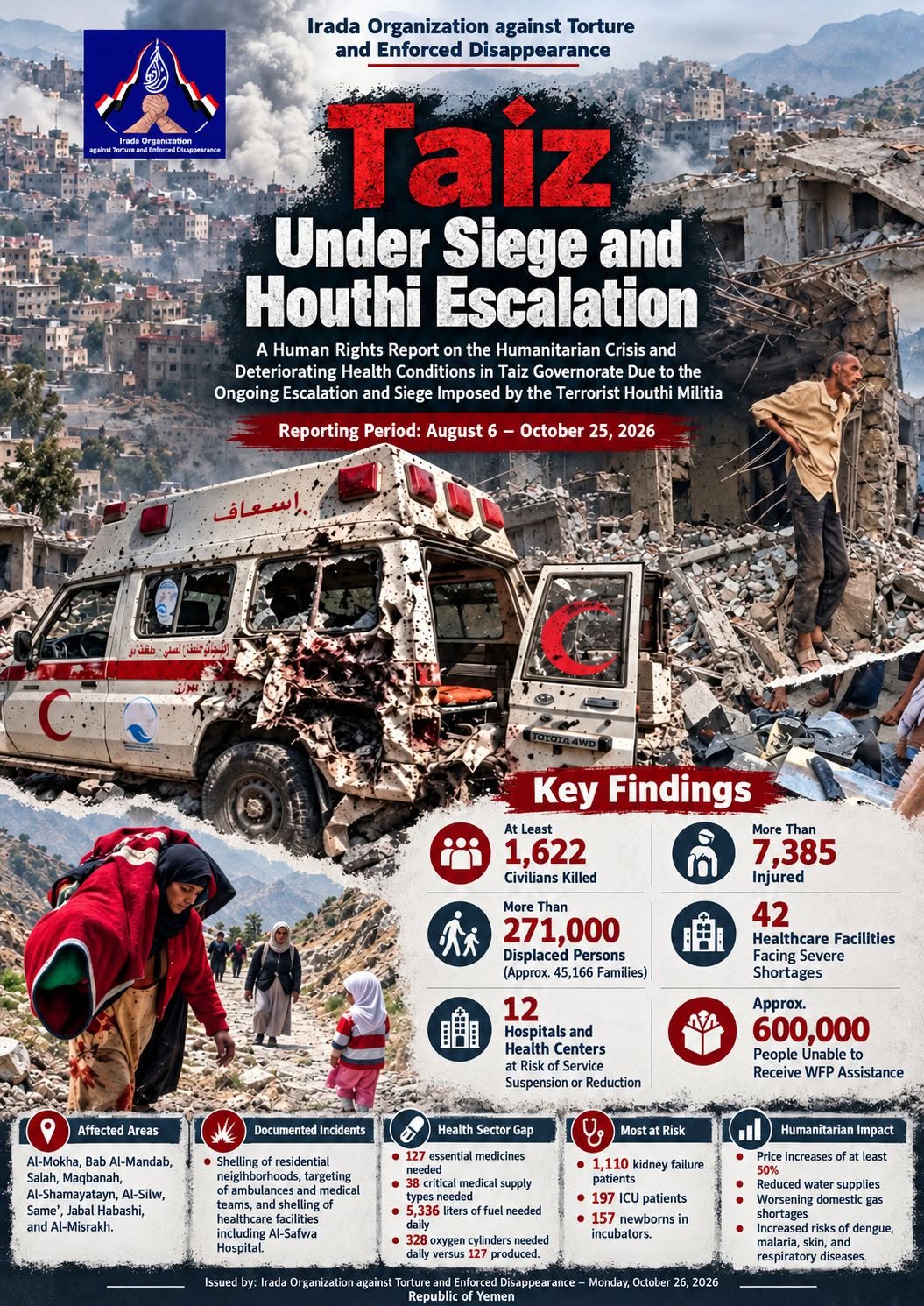
Taiz is under the Houthi siege, and the humanitarian and health sectors are threatened with collapse.
A Human Rights Report on:
The Humanitarian Crisis and Deteriorating Health Conditions in Taiz Governorate Due to the Ongoing Escalation and Siege Imposed by the Terrorist Houthi Militia
Reporting Period: August 6 – October 25, 2026
1\. Introduction and General Context:
A large segment of the civilian population in Taiz Governorate is experiencing extremely dangerous humanitarian and health conditions as a result of the ongoing military escalation and combat operations carried out by the terrorist Houthi militia in the governorate.
These operations have been accompanied by large numbers of civilian casualties, deliberate targeting of residential neighborhoods, healthcare facilities, and medical personnel, escalating waves of displacement and forced displacement, as well as the tightening of the siege and the obstruction of access to essential supplies and humanitarian assistance, in flagrant violations affecting the rights to life, physical integrity, health, and a dignified life.
Field data and human rights documentation issued by Irada Organization against Torture and Enforced Disappearance indicate that the situation in Taiz is extremely dangerous, threatening the lives of hundreds of thousands of civilians and exposing patients, the wounded, children, women, and the elderly to the risk of death as a result of continued Houthi attacks, shortages of food, water, fuel, oxygen, and medicines, and the declining capacity of hospitals to provide their essential services.
2\. Human Casualties and Waves of Forced Displacement Resulting from Houthi Escalation:
According to data documented by Irada Organization concerning the period from August 6 to October 25, 2026, the escalation and attacks led by the terrorist Houthi militia in Taiz Governorate have resulted in the following consequences:
– Civilian casualties: Military operations and artillery and indiscriminate shelling carried out by the Houthi militia against populated areas, including neighborhoods in central Taiz city and several districts and surrounding areas, have resulted in the killing of at least 1,622 civilians and the injury of more than 7,385 others.
– Affected areas: According to information available to Irada Organization, the areas affected by Houthi shelling and the siege include Al-Mokha, areas of Bab Al-Mandab, and the districts of Salah, Maqbanah, Al-Shamayatayn, Al-Silw, Same’, Jabal Habashi, and Al-Misrakh. Concerns are growing over the expansion of civilian damage and the worsening of human casualties.
– Displacement and forced displacement:
Data indicate that more than 271,000 people, equivalent to approximately 45,166 families, were displaced during the same period as a result of the attacks and the deterioration of security and humanitarian conditions caused by the Houthi militia.
– Social and humanitarian impact of displacement:
Irada Organization affirms that every new wave of displacement resulting from Houthi attacks means uprooting families from their homes, exposing children, women, and the most vulnerable groups to the risks of hunger, disease, and exploitation, and depriving thousands of people of security and stability. Furthermore, the continuation of combat operations in populated areas forces residents to leave their homes under the pressure of fear and increases the risks of family separation, loss of property, and exposure to social violence.
3\. Targeting of Civilians, Facilities, and Medical Personnel by the Terrorist Houthi Militia:
Irada Organization against Torture and Enforced Disappearance has documented a series of incidents supported by field evidence concerning the targeting of civilian objects and the healthcare sector by the Houthi militia:
A. Shelling of Residential Neighborhoods (Documented Examination of Victims)
Houthi shelling has struck residential neighborhoods and civilian areas in Taiz city and its districts, resulting in numerous civilian casualties among women, children, and the elderly, in a serious violation of the right to life and personal security, and further aggravating the suffering of residents inside their homes.
The following is a documented sample of victims’ names (according to the latest data and medical reports issued by Al-Thawra General Hospital) resulting from repeated Houthi shelling of the neighborhoods and areas of Sinah, Al-Masbah, and Sabr Al-Shaqab:
First: Deaths:
* Mohammed Qasim Ali (in his sixties).
* Raghad Jamil Saeed Abdu (20 years old) – A resident of the Sinah area, who arrived at the hospital deceased after sustaining multiple shrapnel wounds to various parts of her body.
* Mushirah Mohammed Qasim Ali Abdullah Al-Naqib (35 years old) – A resident of the Sabr Al-Shaqab area, who was injured as a result of the shelling and arrived deceased due to her severe injuries caused by multiple shrapnel wounds.
Second: The Wounded and Injured:
* Maram Anis Ali Murshid (17 years old) – Sustained a shrapnel injury to the chest in the Al-Masbah area.
* Enas Mahyoub Ali Nasr (30 years old) – Sustained shrapnel injuries to the chest, face, and neck in the Sinah area.
* Imad Mahyoub Ali Nasr (34 years old) – Sustained multiple shrapnel injuries to various parts of his body in the Sinah area.
* Saba Ali Numan Abdu (25 years old) – Sustained shrapnel injuries to the head in the Sinah area.
* Child/Rayan Aziz Mahyoub Saleh (5 years old) – Sustained multiple shrapnel injuries to his body in the Sinah area.
* Child/Raneen Aziz Mahyoub Saleh (2 years old) – Sustained multiple shrapnel injuries to her body in the Sinah area.
* Rayhana Jamal Abdu Mohammed (25 years old) – Sustained multiple shrapnel injuries to various parts of her body in the Sinah area.
Irada Organization affirms that civilian lives are not expendable at the hands of the terrorist Houthi militia, and that any attack deliberately targeting civilians, or carried out indiscriminately by the Houthi militia, constitutes a serious violation of the rules of international humanitarian law and amounts to a war crime once its legal elements have been established.
B. Targeting of Ambulances and Medical Teams:
An incident involving the direct targeting of an ambulance by the Houthi militia in the Al-Sarari area of Sabr Al-Mawadim District on October 20, 2026, was documented. The ambulance was transporting an injured girl when it was attacked, resulting in the killing of the driver (Hussam Numan Al-Jaradi) and the injured girl, and causing serious injuries to the accompanying paramedic.
Irada Organization affirms that the targeting of ambulances and medical personnel protected under international humanitarian law by the Houthi militia constitutes a grave violation requiring investigation and criminal accountability.
C. Shelling of Healthcare Facilities:
Field reports indicate that medical facilities inside Taiz city have been subjected to direct artillery shelling carried out by the Houthi militia, including Al-Safwa Hospital in the city center. These attacks have reportedly resulted in injuries among civilians and material damage to hospital departments.
Irada Organization stresses that hospitals and healthcare centers enjoy special protection under international humanitarian law, which the Houthi militia violates through its direct targeting of these facilities.
4\. Assessment of the Healthcare Sector and the Gap in Medical Needs Resulting from the Houthi Siege:
Health information received by Irada Organization indicates that 42 healthcare facilities are facing severe shortages of supplies and oxygen, while 12 hospitals and healthcare centers are at risk of suspending or reducing their services. In addition, 48 primary healthcare centers and units have been classified as facing a medium level of threat, as a result of the ongoing Houthi siege and attacks.
The gap between needs and essential supplies is widening, according to the following data:
– Medicines: Needs include 127 essential pharmaceutical items, with available stocks of 115 of these items being sufficient for no more than one week.
– Medical supplies: There is a need for 38 types of essential medical supplies to ensure the continued provision of treatment services.
– Fuel: Thirteen healthcare facilities and services require approximately 5,336 liters of fuel per day, while available stocks are sufficient for only two days.
– Medical oxygen: Daily demand is approximately 328 oxygen cylinders, compared with a production of only 127 cylinders, resulting in a daily shortage of 201 cylinders.
Groups Most at Risk:
More than 1,110 patients with kidney failure, 197 patients in intensive care units, and 157 newborn infants in incubators face direct life-threatening risks due to the severe shortages imposed by the Houthi siege.
Irada Organization warns that the continuation of this situation could lead to the disruption of emergency, surgical, and intensive care departments, as well as the deterioration of dialysis services, childcare, maternal care, and immunization services.
5\. The Siege and the Consequences of Restricting Humanitarian Access and the Starvation Practiced by the Houthi Militia:
The Houthi militia continues to impose restrictions and a suffocating siege on supply routes and humanitarian access to Taiz city, resulting in widespread humanitarian consequences, as documented by Irada Organization:
– Obstruction of relief assistance:
World Food Programme assistance has been unable to reach approximately 600,000 people in the city who have been affected by the disruption of humanitarian access due to Houthi intransigence.
– Living conditions:
Prices have increased by no less than 50%, water supplies have been reduced by half, and shortages of domestic cooking gas have worsened.
– Health and environmental risks:
The deterioration of water and sanitation services and the accumulation of waste increase the risks of the spread of dengue fever, malaria, skin diseases, and respiratory diseases, and exacerbate the suffering of residents, particularly children, women, the elderly, and patients.
Irada Organization affirms that the Houthi militia’s use of starvation against civilians as a method of warfare is prohibited under international humanitarian law
6\. Legal Framework and Criminal Responsibility of the Houthi Militia:
The acts and documented incidents recorded in this report constitute explicit violations of the rules of international humanitarian law and international human rights law, and full criminal responsibility for them rests with the leaders and members of the terrorist Houthi militia:
\- Forced displacement:
Forced displacement is prohibited under international humanitarian law. Irada Organization affirms that the displacement of civilians resulting from Houthi attacks does not exempt the militia from its legal responsibility, nor does it negate the right of displaced persons to protection, assistance, and voluntary, safe, and dignified return.
\- Accountability and international criminal responsibility:
The Rome Statute of the International Criminal Court criminalizes intentionally directing attacks against civilians or medical facilities, or obstructing relief assistance. These are crimes regularly committed by the Houthi militia in Taiz.
\- Obligation to protect:
Irada Organization affirms that endangering the lives of patients and civilians through unlawful attacks or the imposition of the Houthi siege necessitates international criminal legal accountability, as well as the documentation of violations and preservation of evidence to ensure that Houthi perpetrators responsible for these grave crimes do not escape punishment and that justice is secured for the victims.
7\. Recommendations:
Based on the documentation and field data presented in this report, Irada Organization against Torture and Enforced Disappearance recommends the following urgent measures and actions:
To the World Health Organization (WHO) and Médecins Sans Frontières (MSF):
* Irada Organization calls for urgent intervention to support hospitals in Taiz with fuel, oxygen, medicines, and medical supplies.
* Ensure the continuity of healthcare services and protect medical personnel and facilities from ongoing Houthi targeting.### To the International Committee of the Red Cross (ICRC):
* Irada Organization calls for efforts to exert pressure to lift the siege and facilitate the opening of safe humanitarian corridors for the evacuation of the wounded and patients.
* Ensure the protection of ambulances and medical teams from Houthi attacks in accordance with international humanitarian law.
To the World Food Programme (WFP) and the United Nations Office for the Coordination of Humanitarian Affairs (OCHA):
\- Irada Organization calls for intensifying the emergency relief response and ensuring unhindered access to food, water, and humanitarian assistance for civilians, displaced persons, and those besieged as a result of the Houthi siege.
To the Office of the United Nations High Commissioner for Human Rights (OHCHR) and the Human Rights Council:
\- Irada Organization calls for strengthening monitoring, documentation, and independent international investigations into the grave violations committed by the Houthi militia in Taiz, and for determining responsibilities to prevent impunity.
\- Take urgent steps to ensure an independent and impartial international investigation into the Houthi militia’s targeting of the ambulance in the Al-Sarari area (October 20, 2026), and the shelling of medical facilities and residential neighborhoods (including Al-Safwa Hospital), as well as documenting evidence and ensuring justice for the victims and their families.
To the United Nations Children’s Fund (UNICEF):
\- Irada Organization calls for providing urgent support to neonatal incubator units, strengthening maternal and child healthcare services, and providing vaccines and necessary supplies to prevent epidemics resulting from the siege.
To OCHA, the United Nations High Commissioner for Refugees (UNHCR), the International Organization for Migration (IOM), and WFP:
\- Irada Organization calls for intensifying efforts to protect displaced persons and those affected by Houthi violations, providing food, water, shelter, and healthcare, and facilitating the delivery of humanitarian assistance to the most vulnerable groups without discrimination.
To the United Nations, the United Nations Security Council, and the International Community:
\- Irada Organization calls for taking practical and serious steps to deter the terrorist Houthi militia, exert pressure to stop its attacks and lift the siege imposed on Taiz, and ensure respect for international humanitarian law.
\- Investigate external military and logistical support (coming from Iran and other countries): Hold those providing support accountable and examine the extent of their contribution to enabling the militia to continue attacks against residential areas, in accordance with international law and relevant United Nations resolutions.
\- Support efforts aimed at fully restoring the sovereignty of the Yemeni state, preserving its territorial integrity and the independence of its national decision-making, and ending Houthi violations.
\- Activate Chapter VII mechanisms and expand sanctions lists (pursuant to Resolution 2140) against Houthi militia leaders and members involved in the siege of the city and the targeting of civilian and medical objects.
\- Enforce the opening of safe humanitarian corridors to allow the entry of fuel, oxygen, and urgent medical and food assistance, and criminalize the Houthi use of the siege as a method of warfare.
(Issued by: Irada Organization against Torture and Enforced Disappearance – Monday, October 26, 2026)Republic of Yemen