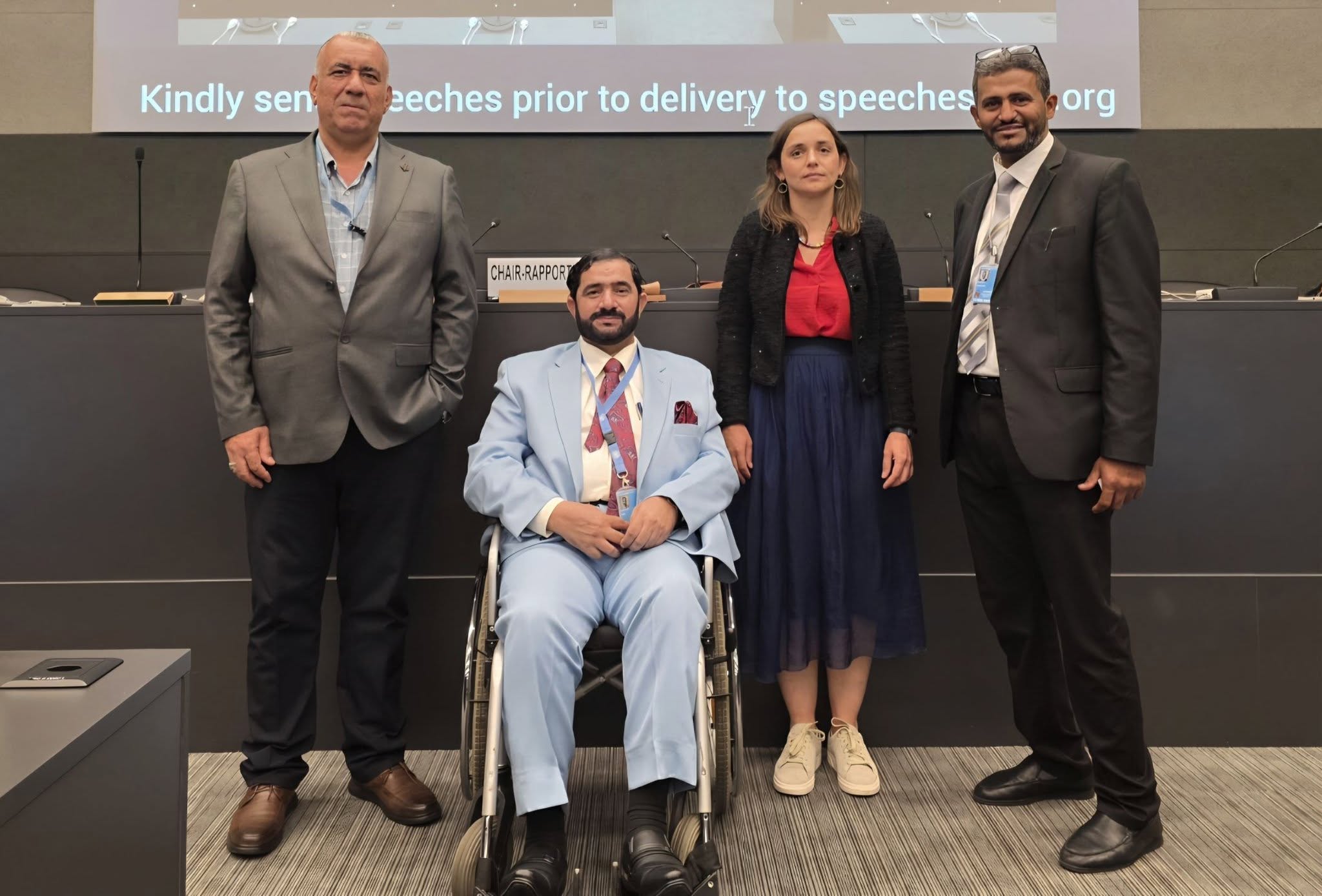
Closed Discussion Seminar at the Palais des Nations in Geneva Addresses the Situation of Violations in Yemen
Geneva – 18 September 2026
A closed discussion seminar was held at the Palais des Nations in Geneva, in Conference Room TEMPUS 3, addressing the situation of violations in Yemen, past and present. The seminar was organized by the United Nations Working Group on Enforced or Involuntary Disappearances.
The seminar was chaired by Ms. Grażyna Baranowska, Chair-Rapporteur of the Working Group on Enforced or Involuntary Disappearances, with the participation of a number of human rights advocates, experts, and individuals concerned with human rights issues. Simultaneous interpretation into six languages was provided during the discussions in the conference room.
The seminar opened with welcoming remarks by the Chair of the Working Group, who welcomed the President of Irada Organization against Torture and Enforced Disappearance, the President of YCVVT, and their accompanying delegation. The floor was then given to Sheikh Jamal Al-Maamari, who welcomed this initiative and humanitarian gesture toward Yemen, expressing his appreciation for the organization of the seminar and for providing an opportunity to discuss the situation of violations and issues concerning victims. Mr. Mohammed Al-Obaidi, the Working Group’s training officer, also delivered remarks. This was followed by extensive discussions, during which questions and inquiries were raised regarding the human rights situation in Yemen, serious human rights violations, and cases of enforced disappearance throughout the years of war.
Sheikh Jamal Al-Maamari delivered an extensive presentation on the situation of arbitrary detention, enforced disappearance, torture, and ill-treatment, including cases of deaths in detention. He also addressed violations against children and women, conditions in prisons and secret detention facilities, available information concerning locations where forcibly disappeared persons are believed to be held, and ways of identifying these locations and linking them to missing-person cases in order to uncover their fate. He also submitted dozens of case files to the Working Group documenting the scale of suffering endured by forcibly disappeared persons.
Part of the discussion was also devoted to the cases of United Nations personnel and staff of international organizations who are detained and forcibly disappeared in prisons run by the Houthi militia. The dire conditions they face in detention were presented, and it was noted that some detainees had died, while others remain in detention, with some facing legal proceedings and trials, including Dr. Ali Al-Madhwahi. The discussion also addressed the pressure and coercion to which some abductees have reportedly been subjected in order to extract confessions relating to allegations of espionage. Participants stressed the need to guarantee their legal rights, rejected these allegations as unfounded, and emphasized the necessity of ensuring their safety and securing their prompt and unconditional release.
Part of the discussions focused on the conditions of prisons and secret detention facilities, identifying their locations and linking them to the case files of forcibly disappeared persons, in a manner that contributes to uncovering their fate, enables their families to learn the truth, and supports accountability for perpetrators of violations.
The conditions of prisons in Houthi-controlled areas were also discussed and compared with detention facilities under the Yemeni government in terms of detention conditions, legal safeguards, and access to detainees. Irada Organization against Torture and Enforced Disappearance & YCVVT presented the violations and methods of torture they had documented, as well as their mechanisms for collecting and verifying information and the risks faced by their sources.
The seminar addressed accountability mechanisms and Yemen’s status in relation to the Rome Statute, as well as calls for Yemen to sign the Rome Statute so that case files could be referred to the International Criminal Court (ICC) within the framework of accountability and efforts to ensure that perpetrators do not enjoy impunity. The discussions also examined the extent to which the parties cooperate with United Nations mechanisms, including concerns raised regarding the failure of the Houthi authorities to respond to communications concerning forcibly disappeared persons.
The discussions further emphasized the importance of developing monitoring and documentation mechanisms, strengthening cooperation with the relevant United Nations mechanisms, and providing them with properly documented case files that can contribute to following up on cases of enforced disappearance and determining the fate and whereabouts of victims. Such efforts would strengthen the protection of detainees, provide justice and reparations for victims, and combat impunity.
The discussions also addressed the gravity of these violations and the need to document them in accordance with professional and legal standards and to preserve relevant evidence and testimonies, thereby strengthening prospects for accountability and redress for victims and their families.
UN Recognition
The seminar witnessed broad recognition from United Nations and international participants of the efforts undertaken by Irada Organization against Torture and Enforced Disappearance and its President, Sheikh Jamal Al-Maamari, in documenting violations involving torture and enforced disappearance in Yemen. In just two years, the organization submitted documentary case files amounting to more than ten times the number submitted during the preceding nine years, when only 32 case files had been submitted.
The UN Working Group’s Chair-Rapporteur praised Sheikh Jamal Al-Maamari, describing him as “a man of strong will” in recognition of his efforts and perseverance despite the risks involved. Participants also emphasized the organization’s credibility and the importance of continuing its professional work to convey the voices of victims and clarify the fate of forcibly disappeared persons, in cooperation with YCVVT.